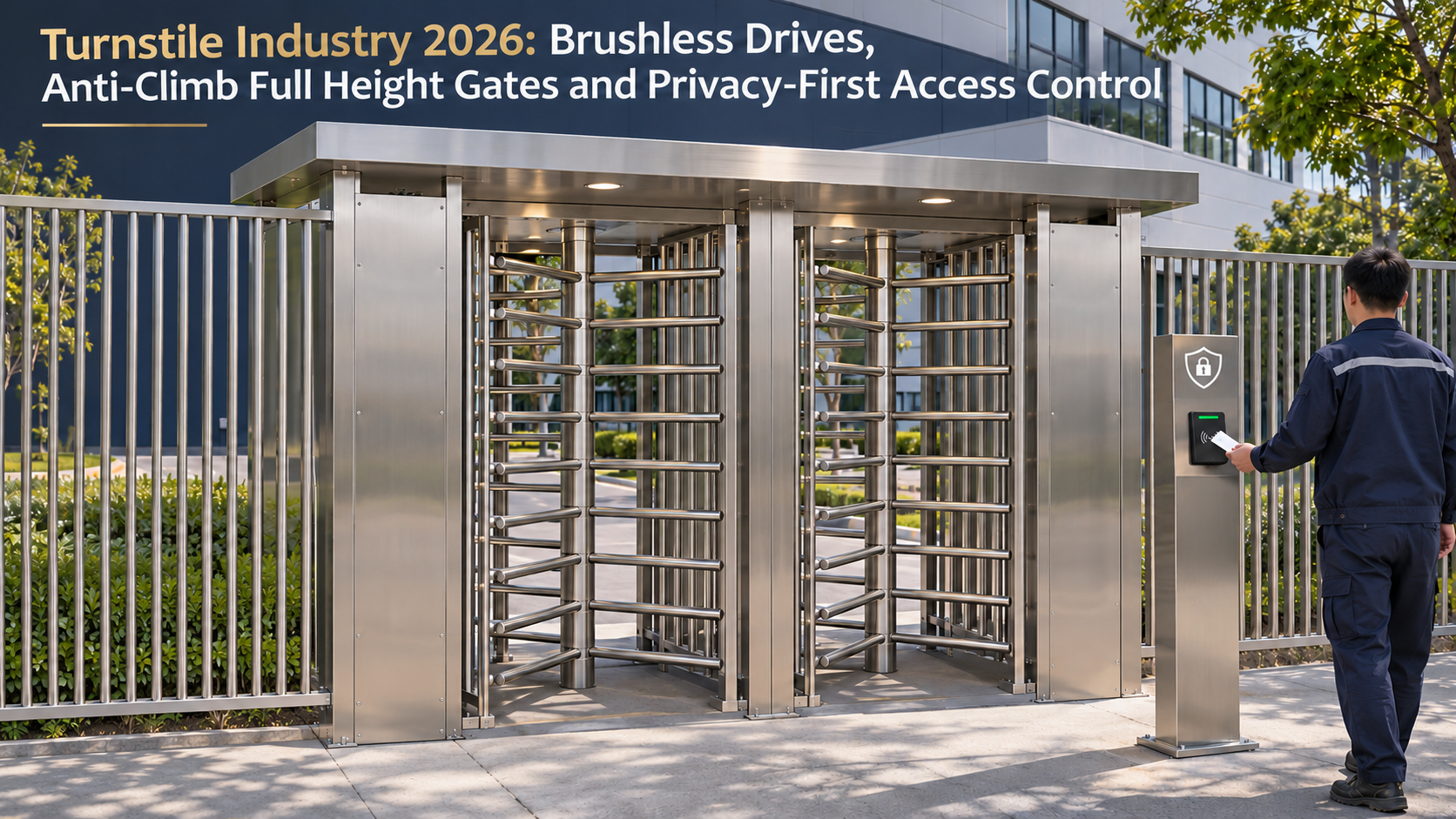
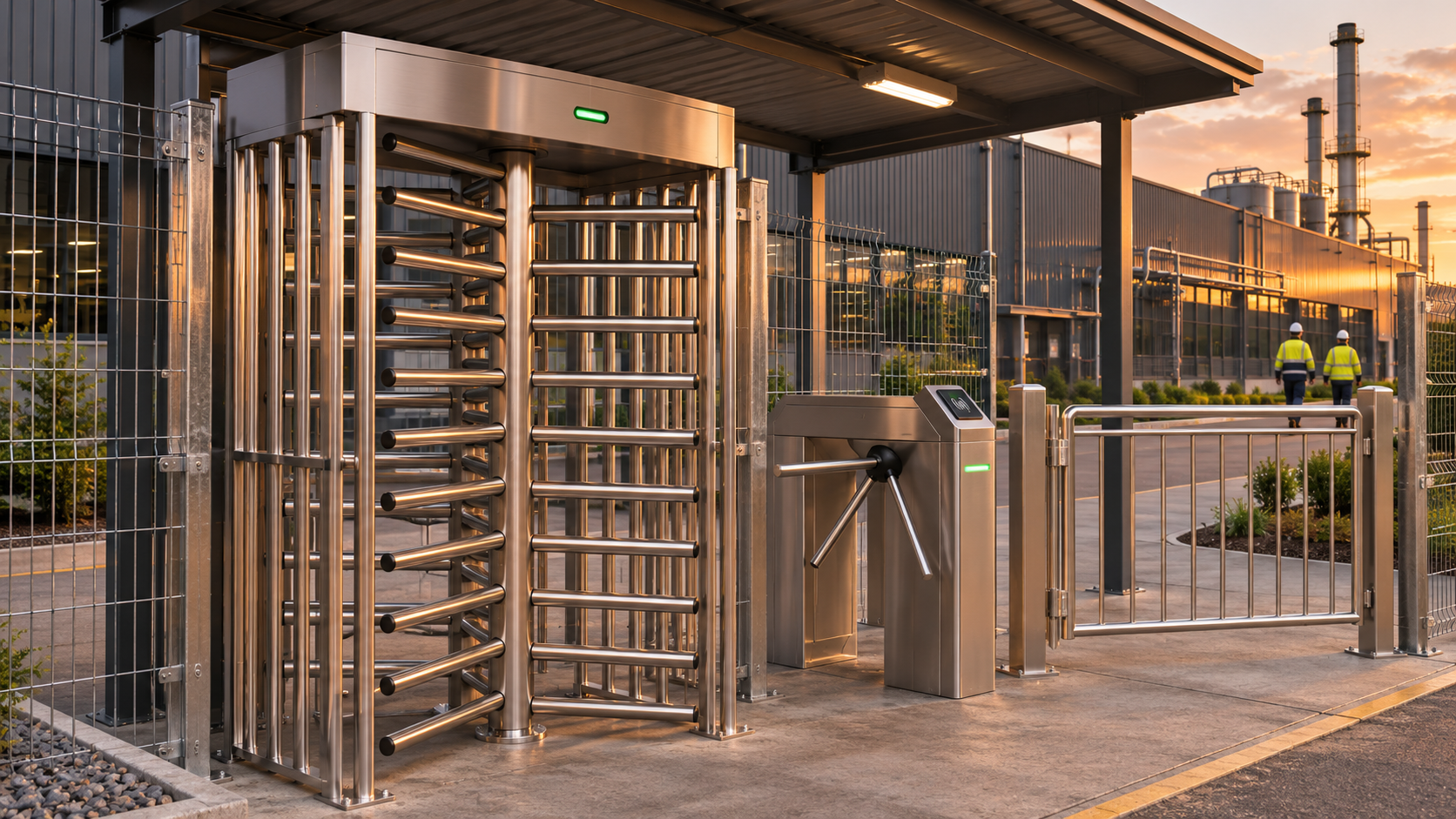
A manufacturing plant in northern China needed to lock down its perimeter pedestrian access against intrusion, climbing and tailgating — without posting a guard at every gate. The plant installed semi-automatic full height turnstiles at its main staff entrance and its restricted workshop corridor. Years into service the units run continuously with no recorded failure.
Customer Background
Location: Northern China — cold winters, dust, wide seasonal temperature swing
Sector: Manufacturing / industrial plant
Access points: Main staff entrance and a restricted workshop corridor
Security requirement: Anti-climb, high-security pedestrian control, strict anti-tailgating
Operating pattern: Two shift changes per day, plus contractor and visitor traffic
The Security Problem
The plant sits on an open industrial estate where perimeter fencing alone was not enough. Three risks drove the specification:
Climbing and vaulting. Waist-high flap or tripod barriers can be stepped over in seconds; the plant needed a barrier tall enough that climbing is impractical.
Tailgating and piggybacking. Two people passing on one authorised card was routine at shift change — and unacceptable to an auditor.
Reverse rotation. Once inside the rotor, arms could be pushed backwards to let a second person slip through.
Delivered Solution and Technical Specification
Parameter
Specification
Security Benefit
Product type
Semi-automatic full height turnstile
Full-height cage enclosure blocks climbing and vaulting
Dimensions
L2400 × W1350 × H2200 mm
2200 mm overall height leaves no handhold or foothold for an intruder
Rotor configuration
120° rotor, three-arm
One person per 120° rotation — the chamber admits a single body at a time
Anti-reverse function
60° anti-reverse lock
Arms cannot be pushed backwards mid-transit; removes the piggyback route
Tailgating control
Single-entry chamber logic
Each authorised card yields exactly one rotation, one person
Mechanism
Yellow galvanised movement assembly
Zinc coating resists corrosion and abrasion in dust-heavy conditions
Operation mode
Semi-automatic (manual push, damped return)
No motor wear from constant cycling; safe for high-volume shift traffic
Service record
5–8 years, no failure reported
Verified by customer after multi-year field operation
Why Semi-Automatic Full Height Was the Right Choice
Motorised full height units are fast, but the motor is the part most exposed to wear at two heavy shift changes a day, and a dead gate at shift handover is an operational crisis. A semi-automatic unit removes the risk: the user pushes the rotor through and a damped mechanism returns it home. No drive motor cycling hundreds of times daily, no controller to fail, and no power failure that can trap someone in the chamber.
How the Anti-Climb and Anti-Tailgating Design Works
Anti-climb. At 2200 mm high with enclosed side panels and a 1350 mm wide cage, the structure presents no grip point. The rotor arms sit well above waist height, so nobody can lever over the top or squeeze between arms and frame.
120° rotor, one person per rotation. The three-arm rotor divides the chamber into three 120° sectors. Pushing through advances exactly one sector — the geometry itself enforces single-person entry, independent of software.
60° anti-reverse lock. Once the rotor moves 60° past home, a mechanical lock engages and the arms cannot be driven backwards. A tailgater following a cardholder has no route through; the second person is physically excluded.
Durability in a Northern China Climate
Sub-zero winters, wind-blown grit and heavy summer dust are hard on outdoor hardware. The galvanised yellow mechanism was chosen for exactly that: the zinc layer sacrifices itself before the base steel, so rotor bearing surfaces and locking pawls stay free of rust and abrasion. With a semi-automatic architecture the number of wearing components is small — hence 5–8 years of failure-free duty on the original mechanism.
Results and Client Feedback
At the main entrance the new full height turnstiles restored a one-card-one-person rule at peak shift change without adding guard headcount. The workshop corridor is now genuinely restricted: no climbing route exists, and the 60° anti-reverse lock closed the piggyback gap the audit team had flagged. The maintenance log shows no failures across 5–8 years of service.
Conclusion
This northern China factory project shows why the full height turnstile remains the reference solution wherever genuine anti-climb and anti-tailgating performance is required. A 2200 mm enclosure, a 120° single-person rotor, a 60° anti-reverse lock and a wear-resistant galvanised mechanism work together as a mechanical guarantee, and semi-automatic operation takes the motor out of the reliability equation entirely.
In a public university in Guangdong Province, China, the campus management team replaced the ageing entry gates at three high-traffic pedestrian points — the main library entrance, the teaching-building lobby and the dormitory zone — with a bank of brushless flap barrier turnstiles. The campus accommodates more than 20,000 students and staff, and the previous gates simply could not absorb the 7:40–8:20 morning peak. After a competitive tender, the university selected a brushless, economically priced flap barrier configuration that delivered measurable throughput gains without exceeding the capital budget.
Customer Background
Location: Guangdong Province, China (humid subtropical climate, high pedestrian volume)
Sector: Higher education — public university campus
Population served: 20,000+ students, faculty and campus staff
Access points upgraded: Library entrance, teaching-building lobby, dormitory zone
Access credential: Campus smart card / QR code / face recognition integration
Challenges the University Faced
Queue build-up at peak hours. Legacy swing gates allowed roughly 15–18 persons per minute; queues backed up 40–60 metres into the campus plaza every morning.
High maintenance cost. Brushed motors required frequent brush replacement in the humid Guangdong climate, generating recurring labour and downtime.
Safety concerns. Students walking with umbrellas, laptops and backpacks frequently struck the moving wings; the old units had no effective rebound protection.
Budget discipline. As a public institution, the university required an economical solution with a low total cost of ownership across a five-year service life.
Tight installation window. The works had to be completed during the eight-week summer break.
Delivered Solution and Technical Specification
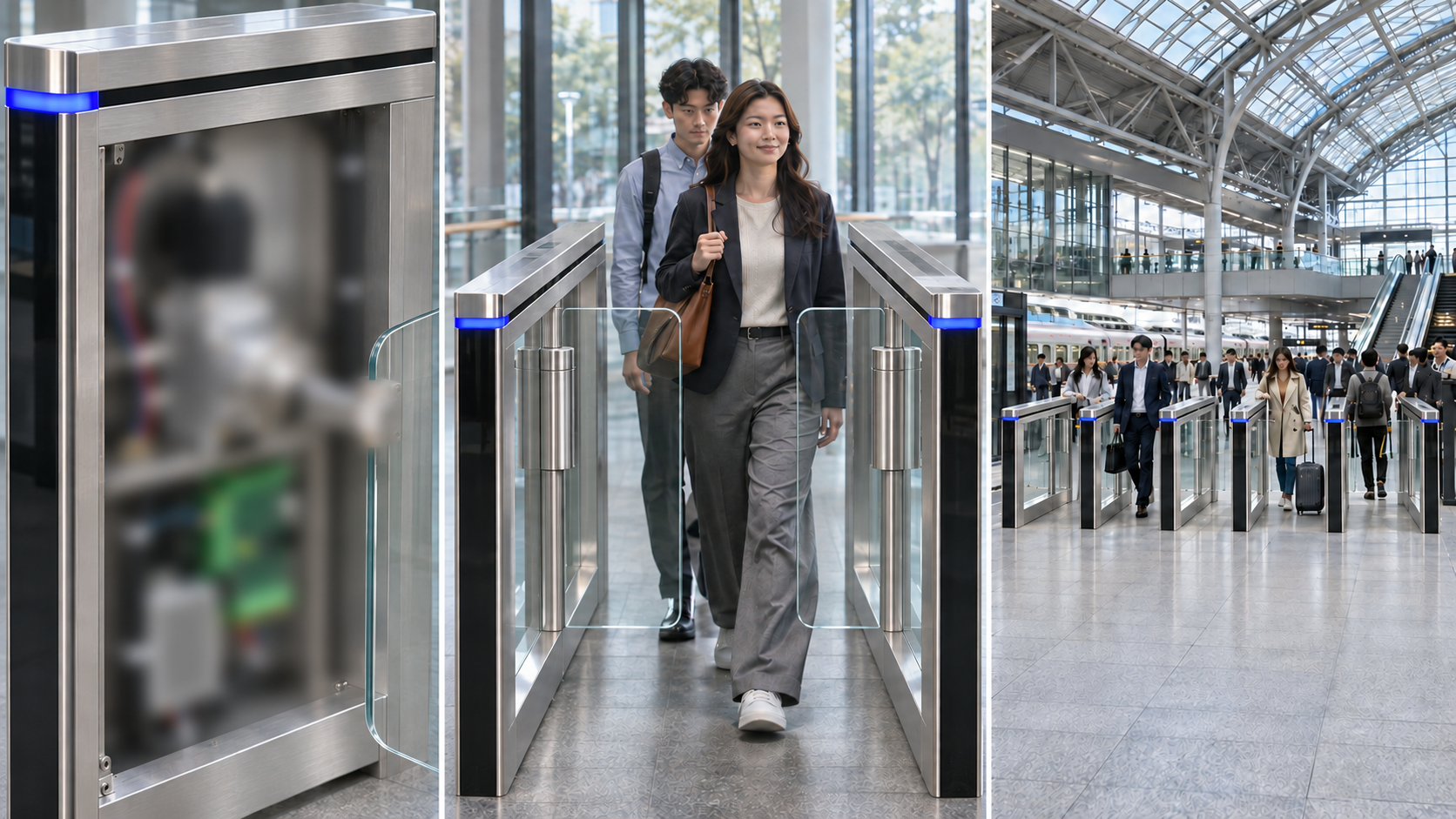
The selected model is a single-lane brushless flap barrier turnstile with transparent acrylic wings, supplied in the compact footprint shown below.
Parameter
Specification
Project Benefit
Dimensions
L1500 × W280 × H990 mm
Compact 280 mm cabinet width preserves corridor space while the 1500 mm length houses a full-length wing travel
Drive system
Brushless DC motor
No carbon brush wear, maintenance-free operation, lower noise and far longer service life
Control board
Brushless motor controller board
Accurate position feedback, smooth acceleration ramp, self-diagnostics on start-up
Barrier wings
Transparent acrylic
Full visibility for security staff, modern appearance, impact-resistant and easy to clean
Throughput
25–30 persons per minute
Roughly 60% higher peak flow than the replaced gates
Collision protection
Mechanical anti-collision + force-resistance anti-collision (dual protection)
Wings absorb and rebound on impact; motor torque limits before injury or damage occurs
Positioning
Economical high-volume configuration
Best cost-per-lane ratio in the tender evaluation
Performance Data After Handover
Metric
Before Upgrade
After Upgrade
Verified throughput per lane
15–18 persons/min
25–30 persons/min
Morning-peak queue length
40–60 m
Under 10 m
Motor brush maintenance
Every 6 months
None required (brushless)
Wing-impact incidents reported
Recurring weekly
Zero injury reports in first semester
Installation duration
—
Completed within the 8-week summer break
How the Dual Anti-Collision Design Works in Practice
Two independent layers protect students at the gate line:
Mechanical anti-collision. The acrylic wing is mounted on a sprung clutch. When a student brushes or strikes the wing, the wing physically gives way instead of stopping dead, then returns to its home position automatically. No motor stall, no broken wing.
Force-resistance anti-collision. The brushless controller continuously monitors motor current. If resistance exceeds the configured threshold — for example a person leaning on the wing — the drive instantly reverses and releases, limiting the applied force well below the level that could cause injury.
For a campus where students walk shoulder-to-shoulder with umbrellas, trolley bags and bicycles at the same time, this combination proved to be the decisive factor in the tender scoring.
Why the Brushless Configuration Was Chosen
Guangdong's humid, salt-laden air is notoriously hard on brushed motors: carbon brushes wear quickly and commutators corrode. By moving to a brushless motor and brushless control board, the university removed the single largest recurring maintenance item from its five-year budget. In parallel, the brushless drive runs quieter — an important point for the library entrance — and delivers more consistent torque across the full wing cycle, which is exactly what sustained 25–30 persons per minute demands.
Results and Client Feedback
Across the first full semester of operation, the three upgraded access points handled the morning peak without a single queue extending beyond the entrance plaza. Campus security reported zero wing-impact injuries, and the facilities team confirmed no motor maintenance was required. The university's project lead summarised the outcome simply: the gates are economical, durable and fast — precisely the three priorities set at the start of the tender.
Conclusion
This Guangdong university project demonstrates that a well-specified, economically positioned brushless flap barrier turnstile can deliver enterprise-grade reliability on a public-institution budget. Compact dimensions, transparent acrylic wings, verified throughput of 25–30 persons per minute and layered mechanical plus force-resistance anti-collision protection together form a repeatable blueprint for campus, factory and office-park access control projects worldwide.
يعد ردهة مبنى المكاتب أحد المداخل الأكثر وضوحًا وسرعة الحركة في أي عقار تجاري. يجب عليه إدارة التدفق اليومي العالي للموظفين والزوار، وأن يبدو أنيقًا بما يكفي ليتناسب مع العلامة التجارية للمبنى، ويمنع الدخول غير المصرح به - كل ذلك في نفس الوقت. تمر هذه الحالة عبر مشروع الوصول إلى الردهة المبني حول بوابات حاجز متأرجح بدون فرش مع اكتشاف الأشعة تحت الحمراء المكون من 8 أزواج والتعرف على الوجه + الوصول إلى رمز الاستجابة السريعة.
خلفية المشروع
كان الموقع عبارة عن الردهة الرئيسية لمبنى مكاتب حديث. احتاجت الإدارة إلى حل للتحكم في المرور من شأنه أن يندمج في تصميم داخلي نظيف ومعاصر أثناء التعامل مع حركة المرور في أوقات الذروة. وكانت المتطلبات الأساسية واضحة:
مظهر أنيق وبسيط يتناسب مع تصميم الردهة
مرور سريع وموثوق للموظفين خلال ساعات الذروة
طريقتان للوصول: التعرف على الوجه ورمز الاستجابة السريعة
الكشف الدقيق عن مكافحة الذيل لمنع الدخول غير المصرح به
ضوضاء منخفضة وعمر خدمة طويل للتشغيل اليومي المستمر
الحل: بوابات حاجز متأرجحة بدون فرش
كان التكوين المختار عبارة عن مجموعة من بوابات حاجز التأرجح بدون فرش مثبتة عند مدخل الردهة. توفر الحواجز المتأرجحة ممرًا طبيعيًا واسعًا يناسب البيئات المكتبية، بينما يوفر المحرك بدون فرش مزايا حقيقية في الردهة التي تعمل طوال اليوم: تشغيل أكثر سلاسة وهدوءًا، وتآكلًا ميكانيكيًا أقل، وكفاءة أعلى في استخدام الطاقة، وتقليل الصيانة على مدار عمر المنتج. توفر خزانة البوابة الرفيعة والمبسطة والتشطيب النظيف المظهر البسيط والأنيق الذي يحتاجه العميل.
8-أزواج كشف بالأشعة تحت الحمراء
تم تجهيز كل حارة بـ 8 أزواج من أجهزة استشعار الأشعة تحت الحمراء. تعمل مجموعة الأشعة تحت الحمراء الكثيفة على تحسين دقة الكشف بشكل كبير: فهي تميز الشخص عن الحقيبة أو العربة، وتتتبع اتجاه الحركة، وتمنع التتبع - وهي وظيفة مهمة للسلامة والأمن في ردهة المكتب حيث يمر الموظفون والزوار جنبًا إلى جنب. كما أن هذا الاستشعار الكثيف يجعل البوابة أسرع وأكثر أمانًا للمشي من خلالها، لأن الأبواب لن تغلق في منتصف الممر للمستخدم الشرعي.
التعرف على الوجه + الوصول إلى رمز الاستجابة السريعة
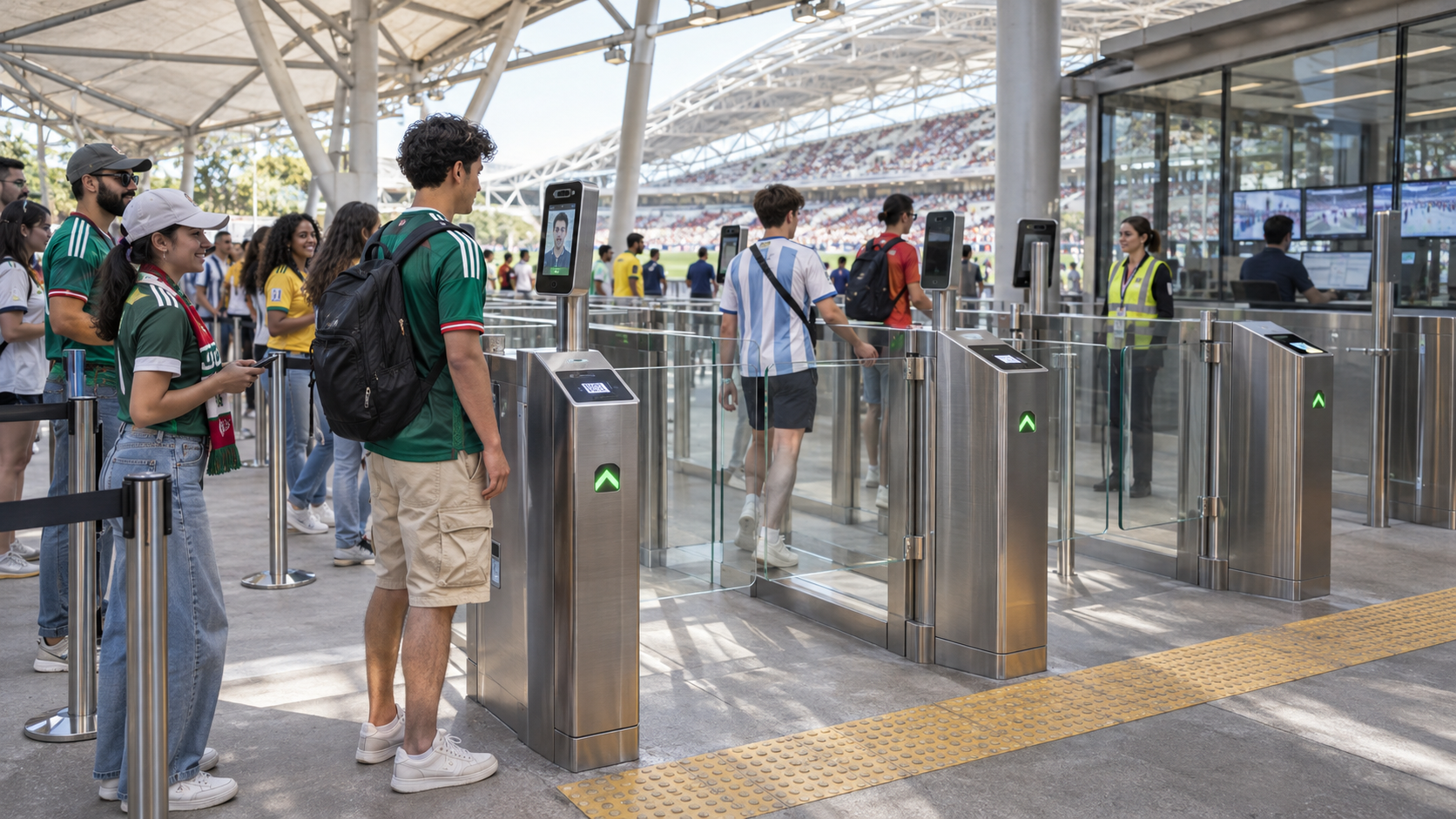
قامت طبقة الوصول بدمج محطات التعرف على الوجه مع قارئات رمز الاستجابة السريعة، مما يمنح المبنى طريقتين متكاملتين للدخول. يمكن للموظفين الدخول بدون استخدام اليدين من خلال التحقق من الوجه، بينما يستخدم الزوار والمقاولين والموظفين المؤقتين رموز الاستجابة السريعة الصادرة من خلال نظام إدارة الزوار. يحافظ هذا المزيج على تجربة مريحة للمستخدمين العاديين ويمكن التحكم بها من قبل الضيوف، دون إضافة بوابة منفصلة أو نقطة تفتيش يدوية.
ملخص تكوين المنتج
غرض
مواصفة
نوع المنتج
بوابة حاجز التأرجح بدون فرش
طلب
البهو الرئيسي لمبنى المكاتب
كشف بالأشعة تحت الحمراء
8 أزواج لكل حارة
طرق الوصول
التعرف على الوجه + رمز الاستجابة السريعة
ينهي
تصميم بسيط وأنيق
الوظائف الرئيسية
مكافحة الذيل، المضادة للتصادم، عملية صامتة
النتائج والفوائد
إنتاجية سلسة في ساعات الذروة مع إمكانية الوصول إلى الوجه بدون استخدام اليدين
إدارة مرنة للزائرين عبر رموز QR
مقاومة موثوقة للخلف بفضل استشعار الأشعة تحت الحمراء المكون من 8 أزواج
محركات هادئة ومنخفضة الصيانة بدون فرش مناسبة للتشغيل طوال اليوم
مدخل نظيف وحديث يكمل صورة العلامة التجارية للمبنى
خاتمة
بالنسبة لردهات المباني المكتبية، يوازن الحل المناسب للتحكم في المرور بين المظهر والسرعة والأمان والموثوقية. من خلال الجمع بين بوابات الحاجز المتأرجح بدون فرش، وكشف الأشعة تحت الحمراء المكون من 8 أزواج والوصول إلى الوجه + QR، يوفر هذا المشروع مدخلاً أنيق المظهر وسهل الاستخدام وآمنًا حسب التصميم - وهو مرجع عملي لمشاريع الردهة التجارية المماثلة.